Wednesday, January 8, 2014

Homemade Peanut Butter and Pumpkin Dog Biscuits!

When I woke up this morning the temperature was -16 and with the wind blowing the last few days it has created wind chill temperatures close to -40 and -50, needless to say it is cold out and it's only early January! To help keep things warm I have done a lot of baking the last few days and decided to try making some home made dog biscuits. Due to the weather the dogs haven't gotten a lot of outdoor exercise so I figured this would help heat up the house and also give them an added bonus to their day! I found a recipe for Peanut Butter and Pumpkin biscuits, here is what it originally called for:


2 1/2 cups whole wheat flour, 2 eggs, 1/2 cup canned pumpkin, 2 tbs. peanut butter, 1/2 tsp salt, and 1/2 tsp. of cinnamon.  Preheat the oven to 350 and whisk the ingredients together in a bowl, adding water as needed to get the dough to the right texture. Roll out the dough, cut into pieces, and bake until hard, about 40 minutes.


I made a few changes: I had a 15oz can of pumpkin so I decided to use the whole thing because it would otherwise have been thrown away and I also did not add the salt. As I was mixing things I added water to get the dough to the right consistency and then just added more flour if it got too thin. Pumpkin is very sticky so as I was rolling the dough out on the cupboard I kept the bag of flour out so that I could add it as necessary to keep it from sticking to everything.


 To create the biscuits I rolled out the dough, used a doggy bone shaped cookie cutter and placed them on the baking sheet.


 Because my treats are small I only baked them for 13 minutes at 350 degrees. Due to having a lot of pumpkin in them the biscuits are softer but did harden a bit after they cooled off.


 Once they were cool enough I took them out to the dogs and they were instantly devoured! They are definitely something I would make again, the recipe is simple and the dogs thoroughly enjoyed them.

UPDATE: About a year after I posted this article some companies started adding an ingredient called Xylitol to their peanut (and other nut) butter, this ingredient is toxic to dogs and can cause death so please be sure to read the ingredients on your peanut butter before feeding it to your dog or using it in treats you make them. Xylitol is a sweetener and is often found in 'sugar free' foods including some peanut butters.


If you're interested in a Cockapoo Puppy please visit our website:
https://www.cutecockapoos.com/puppies-for-sale

Thursday, January 2, 2014

Puppy Vaccinations

A lot of people ask me questions about puppy vaccines and I recently read an article on a website and thought it was very helpful. I have copied some of the original article and also added some of my own thoughts:

Vaccinating a puppy is one of the crucial steps in assuring they will have a healthy and happy puppyhood. The who, what, why, when, where, and how of vaccinations are complicated, and may vary from puppy to puppy. Always consult with your veterinarian to determine which vaccines are appropriate for your puppy. To better understand vaccines, it is important to understand how the puppy is protected from disease the first few weeks of its life.
Protection from the mother (maternal antibodies):
A newborn puppy is not naturally immune to diseases. However, it does have some antibody protection which is derived from its mother's blood via the placenta. The next level of immunity is from antibodies derived from the first milk, called colostrum, which is only produced from the time of birth and continues for the first 36-48 hours. After the first 36-48 hours have passed the puppy does not continue to receive antibodies through its mother's milk, so it is very important to make sure they are nursing well right after born. All antibodies derived from the mother, either via her blood or colostrum are called maternal antibodies. It must be noted that the puppy will only receive antibodies against diseases for which the mother had been recently vaccinated against or exposed to. As an example, a mother that had NOT been vaccinated against or exposed to parvovirus, would not have any antibodies against parvovirus to pass along to her puppies. The puppies then would be susceptible to developing a parvovirus infection. We vaccinate all of our dogs for Parvo so that is not an issue to worry about with our puppies, it was just an example.
Window of susceptibility:
The age at which puppies can effectively be immunized (protected) is proportional to the amount of antibodies the puppy received from its mother. High levels of maternal antibodies present in the puppies' bloodstream will block the effectiveness of a vaccine. When the maternal antibodies drop to a low enough level in the puppy, immunization by a commercial vaccine will work.
The antibodies from the mother generally circulate in the newborn's blood for a number of weeks. There is a period of time from several days to several weeks in which the maternal antibodies are too low to provide protection against the disease, but too high to allow a vaccine to work. This period is called the window of susceptibility. This is the time when despite being vaccinated, a puppy or kitten can still contract the disease.
When should puppies be vaccinated?
The length and timing of the window of susceptibility is different in every litter, and even between individuals in a litter. A study of a cross section of different puppies showed that the age at which they were able to respond to a vaccine and develop protection (become immunized) covered a wide period of time. At six weeks of age, 25% of the puppies could be immunized. At 9 weeks of age, 40% of the puppies were able to respond to the vaccine. The number increased to 60% by 16 weeks of age, and by 18 weeks, 95% of the puppies were protected by the vaccine.
Almost all researchers agree that for puppies and kittens, we need to give at least three combination vaccinations and repeat these at one year of age.
Consult with your veterinarian to determine which vaccinations your puppy should receive, and how often.

Some breeders prefer to vaccinate puppies with a combination vaccine at six weeks of age initially, with boosters given every three weeks until the puppy is about sixteen weeks of age. Feeling that this schedule will help protect the widest range of dogs. Realizing that with that protocol, they will be vaccinating some dogs that are not capable of responding, and will be revaccinating some dogs that have already responded and developed a protection. But without doing an individual test on each puppy, it is impossible to determine when the puppy's immune system will be best able to respond. Realizing that in the face of an infection, due to the window of susceptibility, some litters will contract a disease (e.g., parvo) despite being vaccinated. By using quality vaccines and an aggressive vaccination protocol, they can make this window of susceptibility as small as possible. This vaccination protocol may not be right for every puppy. Puppies that are not exposed to other dogs and have a very small chance of coming in contact with parvovirus, may not need to be vaccinated as frequently. At the same time, some 'high risk' puppies may need a more intense and aggressive vaccination program. It is best to work with your veterinarian on a vaccination protocol that is best for your individual puppy or kennel, taking into consideration your individual situation.
Against which diseases should puppies be vaccinated?
The AVMA Council on Biologic and Therapeutic Agents' Report on Cat and Dog Vaccines has recommneded that the core vaccines for dogs include distemper, canine adenovirus-2 (hepatitis and respiratory disease), canine parvovirus-2 and rabies.
Noncore vaccines include leptospirosis, coronavirus, canine parainfluenza and Bordetella bronchiseptica (both are causes of "kennel cough", and Borrelia burgdorferi (causes Lyme Disease). Consult with your veterinarian to select the proper vaccines for your puppy.
We begin vaccines when our puppies are six weeks of age and always recommend to our adopting families that the puppies continue to get boosters along w/a Rabies vaccine when their puppy is old enough. It is also very important to continue to de-worm your puppy, even though they have been de-wormed here. When our puppies go to their new homes they will have received a Neopar Vaccine ( protects against Parvo,) a Bordetella Vaccine (protects against Kennel Cough,) and a 5-N-1 Vaccine ( protects against canine parvovirus CPV, adenovirus type 1 hepatitis and type 2 respiratory disease, parainfluenza, and distemper. Protects against all known strains of CPV, including CPV-2c. Also protects against 2 types of adenovirus that cause hepatitis and respiratory disease in dogs.) They will have also received several rounds of de-wormers that protect against various worms common amongst animals/puppies. When the puppies go home they come with a vaccination history that has the names, dates, brand, and serial numbers of all vaccines and de-wormers they have received so that their new vet can see what they have had and continue a vaccination schedule as the puppy grows. Vaccines are very important, if you want your puppy to live a long and healthy life please be sure to keep your pets up to date on their shots.
 
If you're interested in seeing what Cockapoo Puppies we have for Sale please visit our website: https://www.cutecockapoos.com/puppies-for-sale

Saturday, December 21, 2013

#1 Question: What Color Will Our Next Litter Be?

One of the most common questions I get from people inquiring about our Cockapoo puppies is " what color will your next litter be?" and the answer is "we don't know." Of course, we can guess based on past litters and the colors of the parents but that still isn't a 100% guarantee on what we will get so I tell people we won't know for sure until they are born. This litter was born on 12/19/13 and I am going to use them as an example to help explain why there can be so many colors in one litter.
The mom of this litter is Willow, she is a Chocolate Miniature Poodle with White accents on her paws and chest, shown below:
The father to this litter is Winston, he is a Chocolate Merle Cocker Spaniel and he has a beautiful mix of light and dark Chocolate throughout his coat with a White chest, shown below:
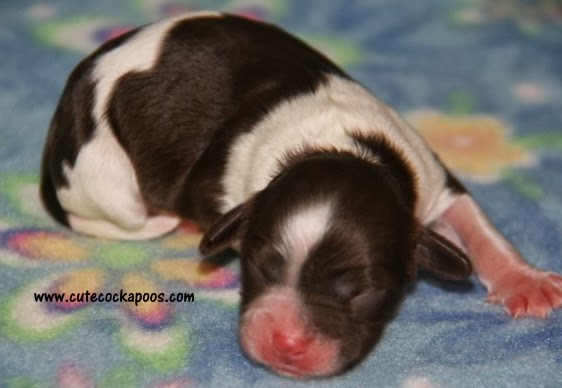
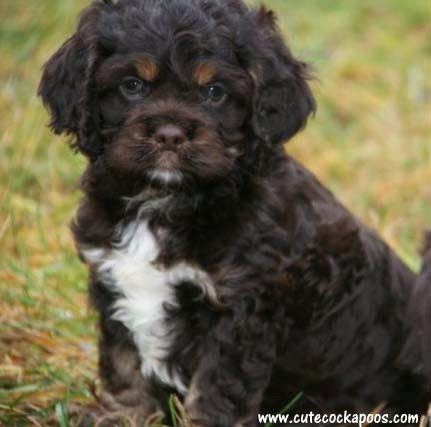
Here are pictures of the litter they had (shown below.) There are two Chocolate and White Parti Colors, one Chocolate Tri Color, one Red w/White accents, and one Chocolate Merle:


Now looking at the parents it's pretty obvious where the Chocolate Merle coloring came from (daddy Winston) but you may be wondering how they ended up with so many other colors and the answer is quite simple, it's all based on the colors in their parents backgrounds. Willow's mom is a Red Miniature Poodle and her father is a Chocolate Tri-Colored Miniature Poodle. Winston's mom is a Chocolate Tri-Colored Cocker Spaniel and his dad is a Black, Silver, and White Merle Cocker Spaniel, so, based on the colors of the grandparents, that would explain where the Red baby and the Chocolate Tri-Colored baby came from, but what about the Parti's? Willow's grandma is a Chocolate and White Parti Miniature Poodle so that's where the Parti babies got their markings from. So from a litter of five babies they got colors and markings going all the way back to three generations in their family history, this is why we can't ever be sure what colors we are going to get! We purposely have dogs that have a lot of different colors in their backgrounds so that we can get a nice mix of color and each litter is a nice surprise!

Monday, December 9, 2013

Congrats to Chester the Cockapoo!

I often tell people that Cockapoos are incredibly smart, they are eager to learn and once they learn something they don't seem to forget it. If they have a dedicated owner the possibilities of what a Cockapoo can become are endless. Here is an email I received a few days ago from a customer with an update on her puppy, more proof of how smart the Cockapoo breed is:

Jamie & Sandy,
 
It has been 1-1/2 years ago since we got our puppy from you. So here is a quick update of my little Chester (Max born 4-14-2012): He is a very lovable, smart dog and so much fun to have. I've trained him in obedience and agility. I started training him in agility in mid January. He has competed in three different AKC Agility trials since October, and we have taken 1st place each time. He is my Blue Ribbon boy! He has earned two titles so far: CGC and NAP (yesterday). We are so proud of him.  Attached are a few pictures of him from his first show. Enjoy. :)
 
Regards,
Cindy
Lomira, WI


Congrats to Chester and his hard working owner, keep up the good work!
If you have adopted a Cockapoo Puppy from us and have a good story about their training please email it to me, we love to see updates, and I may add it to the website and my blog!
 
 
If you're interested in getting a Cockapoo puppy from us please visit our website: https://www.cutecockapoos.com/puppies-for-sale

Saturday, December 7, 2013

A few of my Favorite Cockapoo Puppy pictures!

I take a lot of photos of our puppies and also have some great customers that send me updates as their puppies grow so I thought I would share some of my favorite ones.


If you're interested in one of our Cockapoo Puppies please visit our website: https://www.cutecockapoos.com/puppies-for-sale